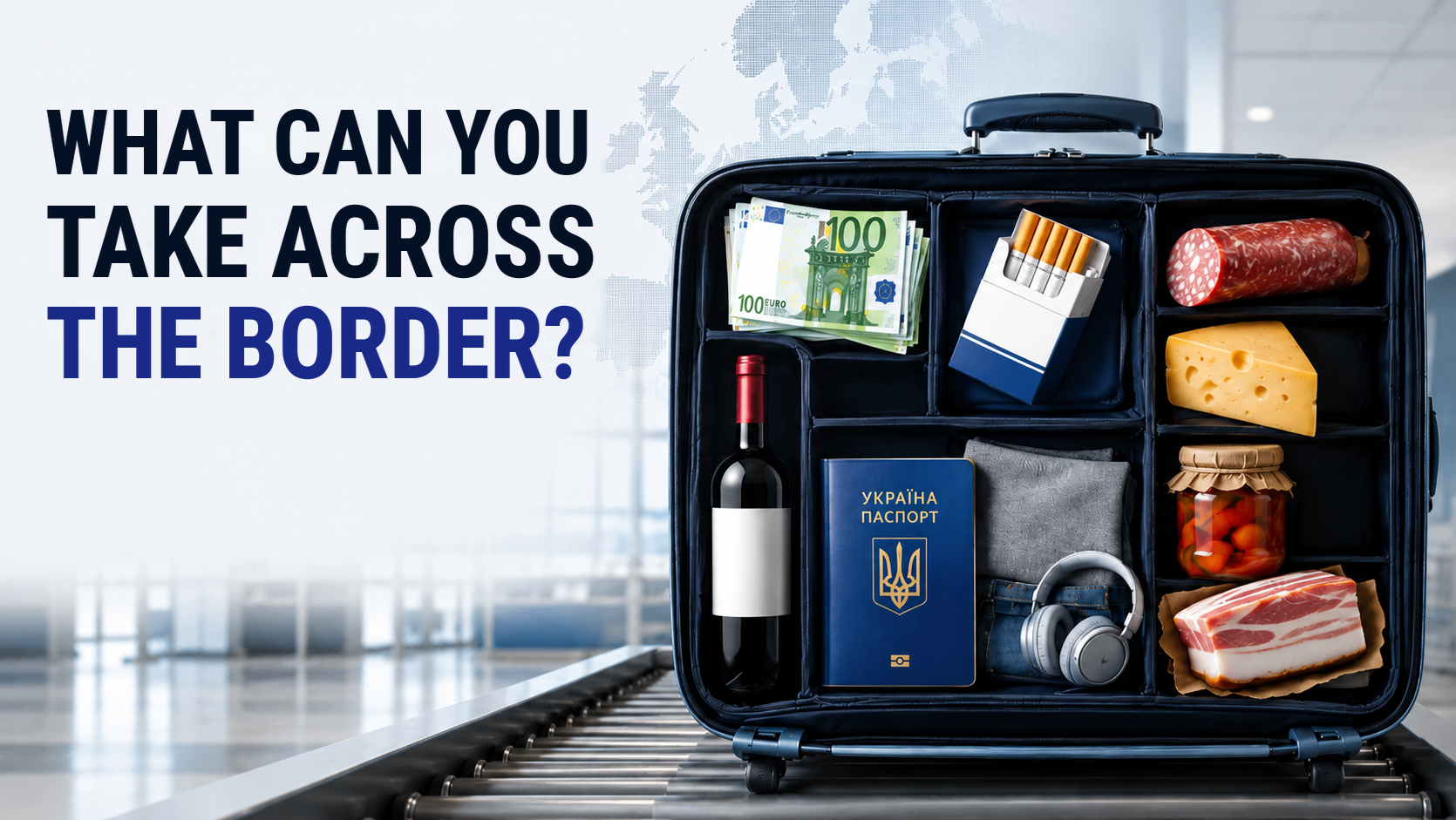
At the border, customs officers check the personal belongings and luggage of Ukrainians travelling abroad.
Below is a list of what you can’t take across the border and which foods you’re allowed to bring with you, based on European legislation and the Customs Code of Ukraine.
Meat and dairy products: a ban with no exceptions
Bringing animal products into EU countries is strictly prohibited. The quantity makes no difference: a suitcase full of home-made food and a cheese sandwich for the journey are banned alike.
- fresh meat of any kind;
- sausages, frankfurters, ham, salo (cured pork fat);
- cheese, butter, milk and other dairy products;
- tinned meat- or milk-based products — stewed meat, pâté, condensed milk.
The restriction is veterinary rather than tax-related, and declaring a product doesn’t lift it: a declared item will be confiscated just the same. The legal basis is Regulation 2019/2122, which applies across the Union.
Fruit and vegetables: why the ‘5 kg’ rule no longer applies
Old advice still says ‘fruit and vegetables — up to 5 kg’, but that rule has been scrapped: since 14 December 2019, plants and fresh plant products from third countries require a phytosanitary certificate, including those in personal luggage. Without one, only five fruits may be brought in: pineapples, bananas, coconuts, dates and durians.
Seedlings, seeds and cut plants can’t be carried either. Processed produce, however, no longer counts as a plant: jam, preserved vegetables, grains, dried fruit, nuts, cooking oil and biscuits cross the border without any trouble.
Which foods you can take across the border
Permitted foods have their own per-person allowances. There’s just one condition: intact original packaging and no need for refrigeration.
| Category | Allowance per person |
| Fish and seafood | up to 20 kg of fish or one whole fish |
| Honey, snails, oysters, mussels | up to 2 kg |
| Baby food and medically required formula | up to 2 kg |
| Food for pets travelling with you | up to 2 kg |
| Sturgeon caviar | up to 125 g |
Formula and pet food are exceptions, so the packaging must be intact. Caviar over 125 g requires a CITES permit, and large quantities of even permitted items won’t be let through.
Restrictions on coffee and tea disappeared back in 2008, when Directive 2007/74/EC abolished them. The figures ‘500 g of coffee, 100 g of tea’ date from those long-gone days.
Alcohol and tobacco: how much and from what age
There are two sets of rules here: you can bring less by land than by air. You choose just one item from the list.
| Product | Land transport | Plane or ferry |
| Cigarettes | 40 | 200 |
| Cigarillos | 20 | 100 |
| Tobacco | 50 g | 250 g |
The lower limit for land journeys applies in Poland, Slovakia, Hungary, Bulgaria, Croatia, Greece, Latvia and Lithuania, while Estonia and Romania apply it to all travellers. Two packs make up exactly those 40 cigarettes, and cigars are limited to 10.
Alcohol is different — how you travel doesn’t matter:
- still wine — up to 4 litres and beer — up to 16 litres; you can bring both;
- plus your choice of no more than 1 litre per person of drinks over 22 % vol. or 2 litres of fortified or sparkling wine.
Poland also limits e-cigarette liquids to 10 ml when crossing by land.
The age limit is 17, not 21. The ‘21 and over’ requirement still crops up in Ukrainian articles, but it doesn’t exist in European law: younger travellers get no allowance for alcohol or tobacco.
Medicines: when you need a prescription
You can take medicines for personal use, and a prescription is not an obstacle but a justification. Only medicinal products containing narcotic or psychotropic substances that are not intended for medical use are prohibited.
For bringing medicines into Ukraine, the rule is straightforward: up to five packs of each product per person; anything more requires a doctor’s prescription with a signature and stamp, and a translation may be needed. The claim that ‘medicines over 500 ml are prohibited’ isn’t supported by current legislation: what counts is the number of packs, not millilitres.
What you can never take across the border
Some items are banned regardless of the country or direction of travel. You won’t get through customs with them either way:
- firearms and their accessories, bladed weapons and air guns;
- ammunition, explosives and gas spray canisters;
- narcotic and psychotropic substances;
- poisonous, toxic and radioactive substances;
- animals and plants of endangered species without a CITES permit;
- minerals regarded as national heritage;
- devices containing pornographic material or unlicensed software;
- counterfeit goods and material inciting violence or racism.
Cultural property is a separate category: works of art, antique books and items of cultural heritage may not be taken out of the country without an export certificate. A special permit for hunting weapons must be arranged in advance.
Cash: the 10 000 euro threshold
You can take cash across the border — it’s simply a matter of declaring it. When leaving, you can take up to the equivalent of 10 000 euros without a written declaration; from that amount upwards, a declaration is mandatory. The threshold is the same when entering Europe, and cheques and gold also count as cash.
Value and weight limits
Apart from the bans, goods are duty-free as long as their value stays within these limits:
- €300 — by bus or car;
- €430 — by plane or ferry;
- €150 — for travellers under 15.
These figures apply to imports into the EU, not to Ukrainian rules, and don’t cover cigarettes, alcohol or fuel.
The claim that ‘more than one household appliance is prohibited’ has no basis: a laptop you use is a personal item. However, it’s worth declaring several identical new devices in advance.
Poland, Slovakia, Hungary, Romania, Czechia, Bulgaria and Moldova
A common question: can you take the same things across the Polish border as across the Slovak one? Yes: all these countries are in the EU, so their food bans and veterinary requirements are the same — only the tobacco figures differ. That’s why lists like ‘Romania — 1 kg of sweets, Hungary — 20 kg of sugar’ are made up.
Moldova is a different matter: it’s outside the EU and its requirements may differ, so it’s worth checking them separately. If your trip takes you through several countries, follow the strictest requirements.
What you can bring across the border into Ukraine
In the other direction, Ukrainian rules apply. Goods worth up to €500 can be brought in duty-free by car or bus, or up to €1000 by air, provided their weight doesn’t exceed 50 kg. Personal items permitted for import (clothes, shoes, gadgets) don’t count towards these amounts and aren’t subject to duty.
The essentials in a minute
Meat and dairy can’t be taken into Europe at all. Plant products need a certificate; processed ones don’t. Fish, honey and baby formula are limited by weight, and cash of 10 000 euros or more must be declared.
Before you travel, check the list on the website of the State Customs Service of Ukraine and on the European Commission page about bringing food across the border: the rules can change without notice.